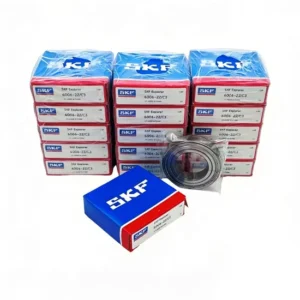
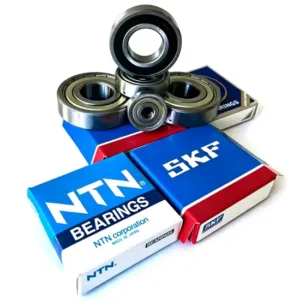
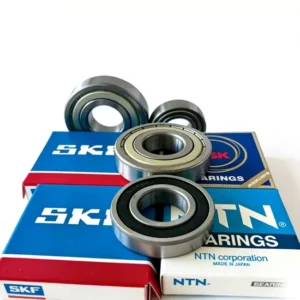
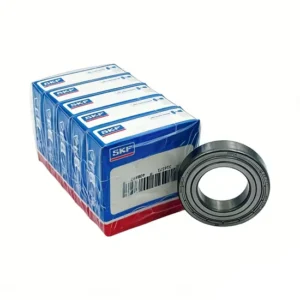
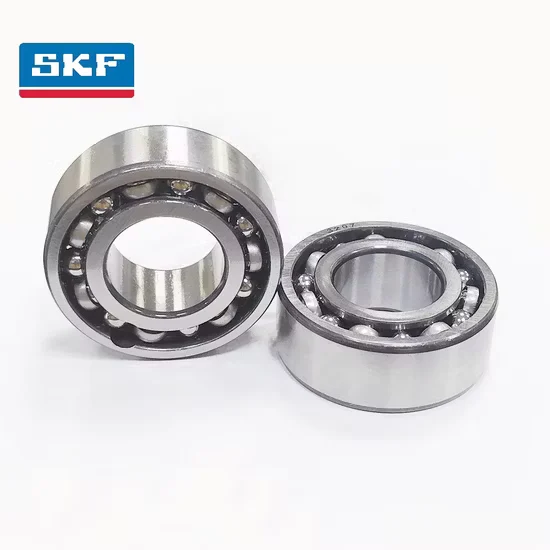
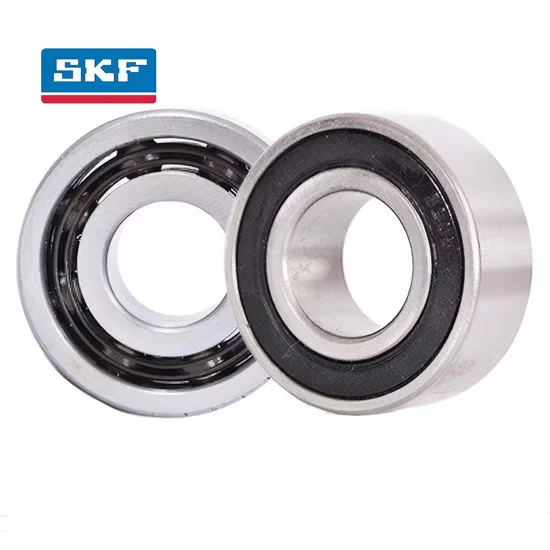
Multi-Brand Sourcing Consolidation — Procure the SKF 6206 deep groove ball bearing alongside other premium lines in a single mixed-model shipment without juggling multiple vendors.
Technical Specifications
| Parameter | Value |
| Designation | SKF 6206 |
| Bore Diameter (d) | 30 mm |
| Outside Diameter (D) | 62 mm |
| Width (B) | 16 mm |
| Precision Class | P0, P6, P5, P4 |
| Material | Bearing Steel |
| Lubrication | Grease or Oil |
| Origin | Sweden |
| HS Code | 8482102000 |
Application Suitability
| Industry | Typical Applications |
| Electric Motor Manufacturing | AC & DC electric motor rotor shafts, small-size motor armatures |
| General Machinery | Pump impeller shafts, conveyor drive rollers, gearbox input shafts |
| Household Appliances | Washing machine drum supports, HVAC blower motor assemblies |
Why Base Model Deep Groove Ball Bearings Overheat in High-Speed Motors
Thermal expansion traps standard clearance races when rotational heat exceeds design limits, causing immediate shaft lockup.
Sourcing an SKF 6206 deep groove ball bearing without rigorously verifying the internal clearance often leads to catastrophic seizure in continuous-duty electric motors. Early in my career handling export documentation in Suzhou, I dispatched a batch of standard clearance replacements for a high-temperature industrial drive project. Ignoring the thermal growth factor caused the inner rings to expand and eliminate all internal play during operation. The resulting shaft lockups triggered severe unplanned downtime and physically damaged the stator windings. This costly mistake proved that basic part numbers hide critical application mismatches, especially when high-speed rotation generates substantial frictional heat that standard configurations cannot accommodate.

Matching Rotational Dynamics to Motor Shaft Requirements
Electric motor armatures demand exceptional rotational smoothness to minimize electromagnetic interference and suppress acoustic vibration across the operating frequency spectrum. Supplying the correct SKF 6206 deep groove ball bearing requires matching the specific precision class to the motor's exact tolerance stack-up and dynamic balancing requirements. Our engineering team cross-references your RPM profiles, radial load vectors, and housing rigidity data to ensure the selected unit maintains optimal radial play. This precise alignment prevents micro-slip and ensures the motor operates quietly throughout its intended service lifecycle.
Managing Thermal and Acoustic Demands in Continuous Operation
High-speed motor shafts generate substantial frictional heat, directly impacting the internal clearance and altering the lubricant viscosity within the contact zone. Selecting between grease and oil lubrication depends entirely on the cooling mechanism, ambient conditions, and maintenance intervals of the specific appliance or industrial drive assembly. Achieving genuine low-noise operation requires strict control over raceway surface finish, rolling element sphericity, and the harmonic damping characteristics of the cage design. Furthermore, external contaminants introduced through inadequate housing seals can rapidly degrade the acoustic signature and accelerate surface fatigue.
Decoding Precision and Material Baselines for Electric Drives
The SKF 6206 deep groove ball bearing features a 30 mm bore and 62 mm outside diameter, fitting standard metric motor housings directly. Available in P0 through P4 precision classes, the tighter tolerances directly reduce vibration amplitudes and acoustic emissions in high-speed armatures. Available in premium bearing steel variants, the rings and rolling elements provide reliable load capacity for typical radial motor loads while resisting surface deformation. Lubrication options include both grease and oil, allowing integration into sealed lifetime-lubricated household appliances or continuously oiled industrial gearboxes. Since this base designation carries no suffix, it represents the standard open configuration, requiring careful verification of external sealing arrangements and precise internal clearance selection to accommodate thermal shaft growth.
The Cascading Impact of Incorrect Clearance Selection
Specifying a standard clearance unit for an application requiring extra clearance leads to dangerous preload buildup as the motor shaft expands under load. This condition accelerates fatigue spalling, generates excessive acoustic noise, and ultimately results in premature catastrophic failure. According to established failure analysis frameworks, improper internal clearance management is a primary root cause of early seizure in continuous-duty electric motors. Correcting this mismatch prevents severe damage to the expensive motor windings, avoids costly warranty voidance, and eliminates the hidden expenses associated with emergency production line stoppages.
Securing Authentic Motor Bearings Through Traceable Channels
Procuring genuine motor bearings requires strict supply chain control to avoid counterfeit units that inevitably fail under high-speed rotation. We maintain massive spot inventory of standard part numbers, ensuring rapid dispatch for urgent MRO replacements when production lines face unexpected breakdowns. Our technical team provides cross-brand equivalent model consultation when exact lead times fluctuate, keeping your assembly schedules intact. Every shipment includes complete traceability documentation, verifying the Swedish origin and material certifications for full audit compliance. We also offer flexible consolidation, allowing you to mix this specific deep groove ball bearing with other critical maintenance parts in a single container to optimize freight costs.
Documentation & Authenticity
- Certificate of Conformity confirming Swedish origin for the 30x62x16 mm dimensions.
- Original manufacturer batch codes traceable via official brand verification applications.
- Material inspection reports validating the bearing steel metallurgy for motor shafts.
- Dimensional inspection records confirming P0 to P4 tolerance compliance before dispatch.
- Customs declaration files supporting the 8482102000 HS code for global shipping.
Storage, Handling & Mounting
- Retain original packaging to prevent moisture ingress, protecting the open bearing steel raceways from corrosion before motor assembly.
- Use clean lint-free gloves during handling to avoid transferring skin oils onto the high-precision P4 raceway surfaces.
- Apply induction heating for inner ring mounting, ensuring uniform thermal expansion without damaging the 30 mm bore.
- Verify external seal integration, as the base designation lacks built-in contact shields for contaminant exclusion.
- Store in a climate-controlled environment to preserve the factory-applied rust preventive coating on the 62 mm outer ring.
Preparing Your Technical Parameters for Selection Review
To ensure the selected unit perfectly matches your motor design, please share the exact radial loads, operational RPM limits, and steady-state operating temperatures. Providing the OEM equipment model number allows our engineers to perform accurate cross-reference verification and identify any historical design updates. Detailing the housing design and external seal configuration helps us advise on the necessary internal clearance adjustments and optimal lubrication strategy for your specific application environment.
Frequently Asked Questions
Q: How do I verify the authenticity of the received units?
A: You can authenticate the units by scanning the QR codes on the packaging using the manufacturer's official mobile application. Additionally, we provide original batch numbers and material certificates that trace the production history back to the Swedish facilities, ensuring complete supply chain transparency for your motor assembly line.
Q: What are the practical differences between P0, P6, P5, and P4 precision ratings?
A: Standard P0 class suits general machinery, while P6 and P5 reduce vibration for standard electric motors. The P4 precision class offers the tightest dimensional and running accuracy tolerances, which is critical for high-speed AC and DC motors where minimal acoustic noise and precise shaft positioning are strictly required.
Q: How should I choose between grease and oil lubrication for high-speed motors?
A: Grease is ideal for sealed, maintenance-free household appliances and small motors due to its simplicity. Oil lubrication is preferred for large industrial drives or gearboxes where continuous cooling and heat dissipation are necessary. The choice depends on your specific motor cooling design and maintenance accessibility.
Q: What installation practices prevent damage to the bearing during motor assembly?
A: Always apply mounting forces directly to the inner ring when pressing onto the motor shaft to avoid brinelling the raceways. Utilize induction heaters for controlled thermal expansion rather than open flames. Ensure the shaft and housing shoulders are perfectly square to prevent misalignment and subsequent premature fatigue.