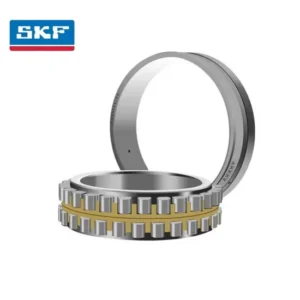
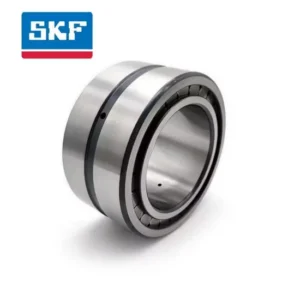
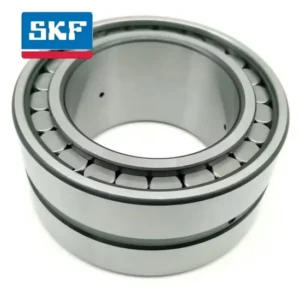
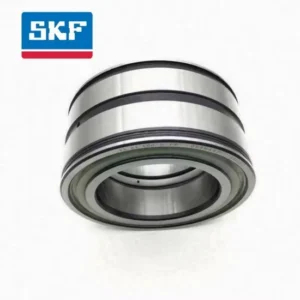
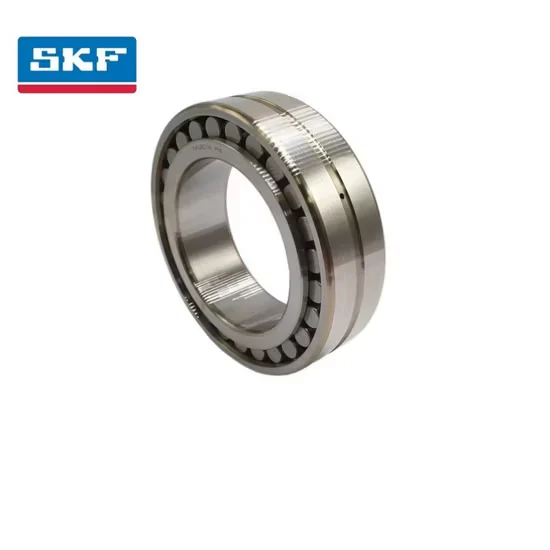
Official App Verification — Every Nu324 Ec M/C3 Vl0241 cylindrical roller bearing we dispatch includes a scannable QR code linking directly to the manufacturer's authentication database.
Technical Specifications
| Parameter | Value |
| Designation | Nu324 Ec M/C3 Vl0241 |
| Bearing Type | Cylindrical Roller Bearing |
| Bore Diameter (d) | 120 mm |
| Outside Diameter (D) | 260 mm |
| Width (B) | 55 mm |
| Dynamic Load Rating (C) | 610 kN |
| Static Load Rating (C₀) | 620 kN |
| Limiting Speed | 3200 r/min |
| Cage Material | Machined Brass |
| Clearance Class | C3 |
| Material | Bearing Steel |
| Origin | Jiangsu China |
Note: The Ec and Vl0241 suffixes remain unverified in standard catalogs and require specific manufacturer documentation for exact decoding.
Application Suitability
| Industry | Typical Applications |
| Heavy Machinery | Main drive shafts in heavy-duty gearboxes |
| Metallurgy | Work roll and backup roll necks in rolling mills |
| Rail Transit | Traction motor suspension and drive systems |
Why Thermal Expansion Destroys Rolling Mill Bearings Before Fatigue Does
Selecting the correct internal clearance is the single most critical defense against catastrophic seizure in high-temperature environments.
Early in my career supplying bearings to steel plants, I watched a standard clearance cylindrical roller bearing seize and burn a roll neck because the thermal expansion wasn't factored into the mounting tolerance. When dealing with a Nu324 Ec M/C3 Vl0241 cylindrical roller bearing, ignoring the heat generated by heavy reduction passes turns standard radial play into a destructive interference fit. The immense friction rapidly degrades the lubricant film, leading to metal-to-metal contact that destroys the raceway geometry long before normal fatigue limits are reached.

Matching the Machined Brass Cage to High-Vibration Gearboxes
Heavy-duty gearboxes subject rolling elements to intense shock loads and continuous vibration that easily fracture stamped steel cages. The machined brass cage in this configuration provides the structural mass and damping characteristics necessary to maintain roller alignment under severe radial stress. Supplying these specific configurations ensures your drive trains maintain operational stability without premature cage fragmentation. When gear teeth mesh under peak torque, the resulting vibration amplitudes demand a cage material that absorbs kinetic energy rather than transferring it directly to the rolling elements, thereby preserving the lubricant film thickness.
Overcoming Thermal and Electrical Challenges in Traction Motors
Traction motors generate significant internal heat and stray electrical currents that degrade standard bearing races. While the C3 clearance compensates for the thermal expansion during continuous high-speed operation, the outer ring coating prevents electrical pitting from shaft currents. Proper lubrication intervals must be strictly maintained to ensure the grease does not carbonize at elevated temperatures, which would otherwise negate the benefits of the optimized internal geometry. Furthermore, the insulating layer must remain completely intact during the pressing operation, as even microscopic scratches can create conductive pathways that allow destructive arcing to reach the inner raceway.
Decoding the Internal Geometry and Clearance Strategy
The internal design optimization increases the roller diameter and contact area, substantially boosting the radial load capacity compared to older standard designs. The C3 clearance class is explicitly engineered to provide extra internal space, accommodating the thermal expansion of the shaft and housing when the Nu324 Ec M/C3 Vl0241 cylindrical roller bearing operates at high temperatures. Machined brass cages offer superior wear resistance and thermal conductivity, allowing the bearing to dissipate friction heat more effectively than polymer alternatives. This specific combination of optimized geometry, expanded clearance, and heavy-duty cage material creates a highly reliable assembly for continuous industrial duty. The precise roller profiling also minimizes edge stress concentrations, ensuring that the load is distributed evenly across the entire contact patch even under slight misalignment conditions.
The Financial Impact of Incorrect Clearance Selection
Installing a standard clearance bearing in a high-heat rolling mill application inevitably leads to internal preload buildup as the shaft expands. This unplanned downtime causes severe secondary damage to the housing and roll neck, resulting in catastrophic equipment failure rather than a simple component swap. Following the fatigue life and damage analysis frameworks outlined in ISO 15243, such misapplications void warranty claims and multiply maintenance costs exponentially. The resulting production halts in continuous metallurgical lines cost significantly more than the initial procurement savings of choosing an incorrectly specified standard clearance alternative.
Securing Authentic Traceability for Critical Drive Components
Sourcing insulated or specialized cylindrical roller bearings often involves managing complex supply chains where suffix misinterpretations lead to incorrect deliveries. We verify every Nu324 Ec M/C3 Vl0241 cylindrical roller bearing against original manufacturer batch records to ensure the cage material and clearance class perfectly match your engineering drawings. Our technical team cross-references equivalent models across major global brands to prevent assembly mismatches. By maintaining massive spot inventory of specialized heavy-load variants, we eliminate the typical multi-week lead times associated with custom factory orders. Furthermore, our failure analysis support helps your maintenance crew identify root causes if operational parameters shift. We also provide detailed mounting guidance to ensure the insulating properties are not compromised during the installation phase.
Documentation & Authenticity
- Certificate of Conformity detailing the specific heat treatment and hardness validation for the bearing steel rings.
- Original manufacturer batch traceability reports linking the physical unit to its production date and raw material lot.
- Official app QR authentication tags applied to the packaging for immediate field verification of the C3 clearance class.
- Dimensional and running accuracy inspection reports confirming the radial internal clearance before dispatch.
Storage, Handling & Mounting
- Store the bearing in its original moisture-barrier packaging until the exact moment of mounting to prevent corrosion on the exposed machined brass cage.
- Utilize induction heating equipment calibrated specifically for the 120 mm bore to achieve the precise thermal expansion needed for a secure shaft fit.
- Never use direct flame or localized spot heating, as uneven thermal gradients can permanently distort the C3 internal clearance.
- Apply clean, lint-free gloves when handling the outer ring coating to prevent skin oils from compromising the insulating surface integrity.
- Ensure the mounting environment is free from abrasive metallurgical dust that could infiltrate the open cage structure during assembly.
Engineering Review and Technical Validation
To guarantee optimal performance, please provide the exact radial and axial load profiles, operating temperature ranges, and shaft speed parameters for your specific application. Sharing the original equipment manufacturer part numbers allows our engineering team to perform a rigorous cross-reference validation. This technical review ensures the selected clearance class and cage material align perfectly with your operational realities.
Frequently Asked Questions
Q: How does the C3 clearance benefit high-temperature rolling mill applications?
A: In rolling mills, the shaft and housing expand significantly due to operational heat. The C3 clearance provides the necessary extra internal space to accommodate this thermal expansion, preventing the rollers from binding against the raceways and avoiding catastrophic seizure during heavy reduction passes.
Q: What is the primary advantage of a machined brass cage over stamped steel?
A: Machined brass offers superior structural integrity and damping characteristics under high-vibration and heavy-shock conditions. It maintains precise roller alignment in demanding gearboxes, resists wear from marginal lubrication, and dissipates friction heat more effectively than lighter stamped alternatives.
Q: How can I verify the authenticity of the specialized outer ring coating?
A: Every unit we supply features a scannable QR code on the packaging that links directly to the manufacturer's authentication database. This allows your receiving department to instantly verify the original batch number, production date, and specific insulation specifications before installation.
Q: Why is cross-referencing critical when replacing insulated cylindrical roller bearings?
A: Insulated bearings have specific coating thicknesses and electrical resistance requirements. Cross-referencing ensures the replacement unit matches the exact dimensional tolerances and insulation properties of the original, preventing electrical pitting and ensuring proper integration into the existing motor housing.