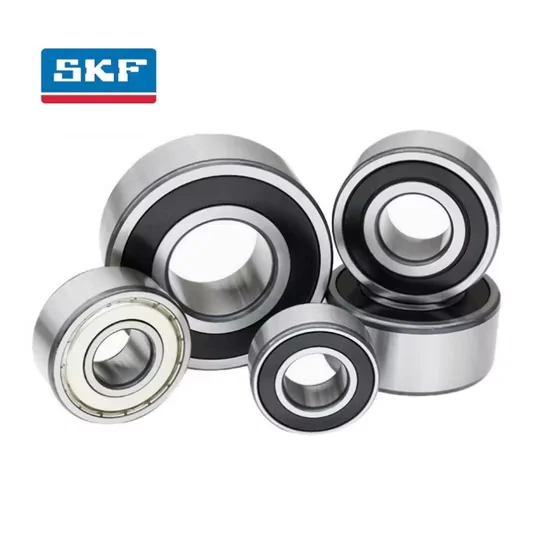
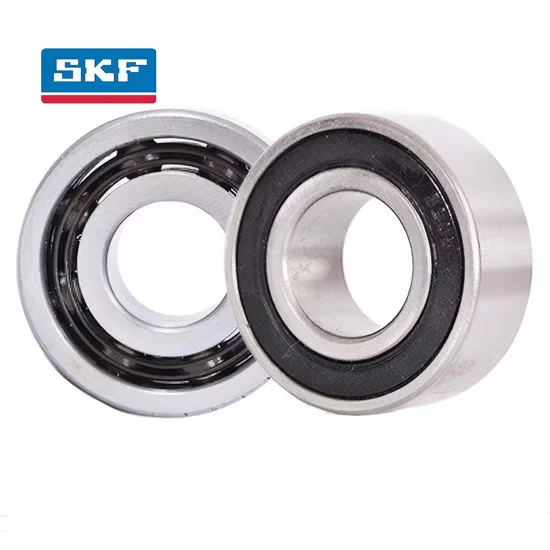
Verify via official app — Scan the QR code on the SKF 3308 a-2z Tn9/Mt33 packaging to confirm factory origin and batch traceability instantly.
Technical Specifications
| Parameter | Value |
| Designation | SKF 3308 a-2z Tn9/Mt33 |
| Bearing Type | Double Row Angular Contact Ball Bearing |
| Contact Angle | 30° |
| Bore Type | Cylindrical |
| Cage Material | Glass fibre reinforced polyamide (TN9) |
| Seal or Shield Type | Double steel shields (2Z) |
| Clearance Class | Standard / C3 / C4 options |
| Precision Class | P0 / P6 / P5 / P4 / P2 |
| Aligning | Non-Aligning |
| Separated | Separated |
| Rows Number | Double |
| Load Direction | Radial and Axial |
| Material | Bearing Steel |
| Lubrication | Grease (MT33) / Oil |
| Origin | Jiangsu China |
Application Suitability
| Industry | Typical Applications |
| Industrial Manufacturing | Transmission systems and gearbox shafts |
| Precision Engineering | Machine tool spindles and indexing heads |
| Fluid Handling | High-speed pumps and compressor rotors |
| Automation | Robotics joint actuators and precision equipment |
When Shielded Bearings Fail in Transmission Systems
Thermal expansion traps standard clearance bearings.
In Nigerian mining gearboxes, I watched standard clearance units seize because heat buildup eliminated internal play entirely. The friction generated by heavy radial loads caused the inner ring to expand, squeezing the rolling elements until the cage fractured. Selecting the right SKF 3308 a-2z Tn9/Mt33 double row angular contact ball bearing requires matching the cage material and shield design to the actual operating temperature, preventing catastrophic lockups and extended production halts.

Matching the Double Row Design to Target Loads
The dual-row configuration handles combined radial and axial forces efficiently, eliminating the need for paired single-row setups in compact gearboxes and pump housings. This integrated design saves axial space while providing the rigidity needed to withstand overturning moments in robotics joints. Our engineering team provides cross-reference consultation to ensure this specific SKF 3308 a-2z Tn9/Mt33 double row angular contact ball bearing aligns with your exact housing dimensions, load profiles, and precision requirements.
Managing Operational Challenges in Precision Equipment
High-speed pump spindles and machine tool axes generate significant heat, demanding a cage material that minimizes friction while maintaining structural integrity under continuous centrifugal force. The double steel shields prevent abrasive dust ingress without the contact friction of rubber seals, yet they require careful consideration of internal grease degradation over time. Misalignment in rigid housings further amplifies edge stresses on the rolling elements, making precise shaft tolerances and careful mounting procedures absolutely critical.
Decoding the Suffix and Specification Matrix
When evaluating the SKF 3308 a-2z Tn9/Mt33 double row angular contact ball bearing, the 30° contact angle optimizes the balance between radial load capacity and axial thrust resistance, making it ideal for gear shafts experiencing mixed loading. The TN9 suffix indicates a glass fibre reinforced polyamide cage, which runs cooler and quieter than pressed steel at elevated speeds while dampening vibration. Meanwhile, the 2Z shields retain the factory-filled grease while effectively blocking coarse metallic particles. The double row design further enhances load distribution across the rolling elements, ensuring stable operation under heavy radial forces.
The Hidden Costs of Incorrect Clearance Selection
Specifying a standard clearance unit for a high-temperature transmission application inevitably leads to preload buildup, excessive friction, and premature fatigue. According to ISO 281 life calculation frameworks, operating a shielded bearing beyond its thermal limit drastically reduces the L10 fatigue life and accelerates lubricant breakdown. This results in unplanned downtime, catastrophic damage to adjacent gearbox components, and voided equipment warranties, ultimately costing far more than the initial component price.
Securing Traceable Inventory for Critical Spares
We maintain massive spot inventory covering thousands of standard and special part numbers, ensuring urgent maintenance requirements are met without multi-week delays. Every shipment includes complete traceability documentation, allowing you to verify the exact production batch of your shielded units. Our technical selection support helps you cross-check unverified suffix codes against official catalogs, preventing costly misapplications in sensitive robotics joints. Furthermore, our competitive sourcing cost provides genuine components without the premium of direct official channels, backed by long-term after-sales failure analysis and global shipping consolidation.
Documentation & Authenticity
- Certificate of Conformity verifying the 30° contact angle and P-class precision tolerances.
- Original factory batch traceability records linked to the specific 2Z shielded production run.
- Official app QR authentication confirming the genuine polyamide cage material.
- Dimensional inspection reports validating the non-aligning bore and outer ring tolerances.
- Material test certificates confirming the bearing steel metallurgical composition.
Storage, Handling & Mounting
- Store the 2Z shielded units in original packaging to prevent humidity from degrading the MT33 grease fill.
- Use clean lint-free gloves when handling the polyamide cage to avoid surface contamination.
- Induction heating is recommended for the inner ring to preserve the precise 30° contact angle geometry during mounting.
- Avoid washing the double steel shields, as solvents can dissolve the factory-applied lubrication.
- Keep the separated components grouped to prevent mixing inner and outer rings from different batches.
Requesting Technical Validation
Share your exact radial and axial load profiles, operating speeds, and ambient temperatures so our engineers can validate the L10 life and clearance class. Providing the OEM equipment model number allows us to perform precise cross-reference checks. This technical review ensures the selected configuration perfectly matches your transmission system requirements.
Frequently Asked Questions
Q: How do I verify the authenticity of the SKF 3308 a-2z Tn9/Mt33 double row angular contact ball bearing using official tools?
A: You can use the manufacturer's official authentication app to scan the QR code printed on the product packaging. This digital verification confirms the factory origin, production batch, and ensures the internal components, such as the polyamide cage and steel shields, match genuine specifications, protecting your equipment from counterfeit risks.
Q: What do the unverified suffixes mean and how can I confirm them?
A: Certain suffix combinations in the identifier require direct manufacturer catalog confirmation to define exact internal geometry or specific grease fill parameters. Our engineering team cross-references these codes with official technical databases to ensure the unit perfectly matches your application's thermal and mechanical requirements before dispatch.
Q: How does the polyamide cage compare to steel or copper cages?
A: The glass fibre reinforced polyamide cage offers lower friction and quieter operation at high speeds compared to metal alternatives. However, it has specific temperature and chemical resistance limits. We evaluate your operating environment to determine if this polymer option or a metallic cage variant better suits your transmission system.
Q: What clearance class should I select for high-temperature gearboxes?
A: High-temperature environments cause thermal expansion that reduces internal play. Selecting a C3 or C4 clearance class compensates for this heat buildup, preventing the bearing from seizing under load. We analyze your specific operating temperatures to recommend the optimal clearance for reliable performance.
Q: Can the double steel shields be removed for relubrication?
A: The 2Z steel shields are permanently pressed into the outer ring grooves to retain factory grease and block contaminants. Removing them typically damages the shield structure and compromises the seal. For applications requiring frequent relubrication, an open or rubber-sealed variant is recommended instead.