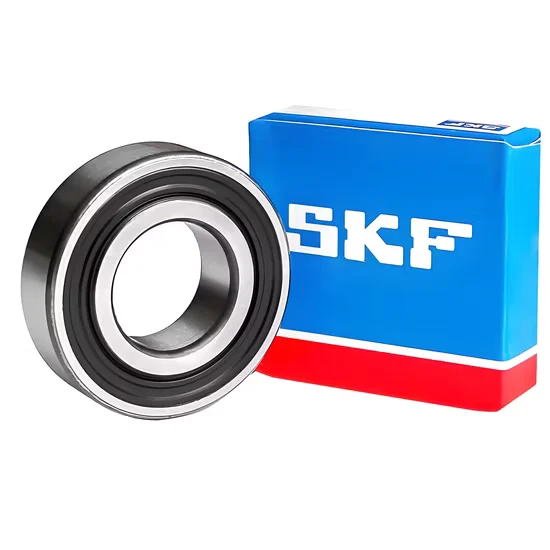
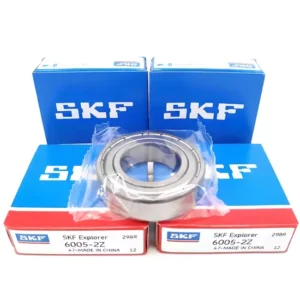
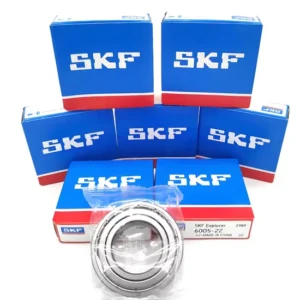
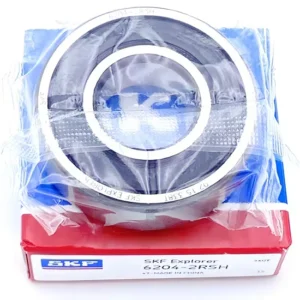
Full Batch Traceability — Every SKF 61900 deep groove ball bearing ships with verifiable factory lot documentation to guarantee authentic material origins.
Technical Specifications
| Parameter | Value |
| Designation | SKF 61900 |
| Product Type | Deep Groove Ball Bearing |
| Bore Diameter (d) | 10 mm |
| Outside Diameter (D) | 22 mm |
| Width (B) | 6 mm |
| Material | Bearing Steel |
| Contact Angle | 0° |
| Number of Rows | Single |
| Load Direction | Radial |
| Arrangement | Non-Aligning, Unseparated |
| Seal or Shield Type | Open |
| Clearance Class | Normal |
Application Suitability
| Industry | Typical Applications |
| Electric Motors | High-speed rotor supports in fractional horsepower motors |
| Pumps | Micro-pump shaft bearings for fluid transfer systems |
| Gearboxes | Low-torque instrument gear train pivot points |
| Household Appliances | Precision spindle supports in small cooling fans |
Why Thin-Wall High-Speed Motors Fail When Clearance Is Ignored
Thermal expansion in tight tolerances rapidly eliminates internal clearance, causing catastrophic rotor seizure.
During a demanding Hannover exhibition project, a high-speed motor client experienced immediate thermal lock-up after assembly. The exceptionally thin cross-section of these micro-bearings leaves absolutely zero margin for thermal growth when standard clearance is applied at high rotational speeds. Selecting the correct SKF 61900 deep groove ball bearing requires anticipating the exact operating temperature delta to prevent the rolling elements from skidding and severely scoring the raceways. When the internal gap closes completely, the frictional heat spikes exponentially, destroying the lubricant film and welding the balls to the cage. This catastrophic failure mode is entirely preventable by understanding the thermal dynamics of thin-walled components in compact electric motors.

Matching the Micro-Bearing to Precision Motor Loads
When integrating a SKF 61900 deep groove ball bearing into compact electric motors or micro-pumps, the primary engineering focus must be on minimizing frictional torque while maintaining absolute shaft rigidity. Our technical team carefully cross-references the exact rotor weight, magnetic pull, and external belt tensions to ensure the standard radial capacity is sufficient without overloading the thin raceways. This precise application matching prevents premature surface fatigue in high-cycle household appliances and precision instrument gearboxes. By analyzing the specific load spectrum, we help you avoid the common pitfall of oversizing the bearing, which inadvertently increases friction and reduces the overall efficiency of fractional horsepower motors.
Managing Speed, Heat, and Lubrication Constraints
Operating a 10 mm bore bearing at elevated speeds generates significant frictional heat, which directly impacts the lubricant's base oil viscosity and structural integrity. If the selected grease cannot effectively dissipate this localized heat, the thin protective film breaks down, leading to destructive metal-to-metal contact between the precision balls and the inner ring. Furthermore, open-type configurations demand a strictly controlled external lubrication environment to prevent microscopic dust ingress from acting as an abrasive lapping compound inside the motor housing. Proper relubrication intervals and the selection of specialized high-speed synthetic lubricants are absolutely critical to sustaining the operational lifespan. Ignoring these thermal and tribological constraints inevitably results in premature degradation of the bearing surfaces.
Decoding the Baseline Specifications and Suffix Implications
Since this specific designation carries no suffix, it defaults to an open design with standard internal clearance and a standard pressed steel cage. The open configuration allows for custom grease packing or continuous oil bath lubrication, making it exceptionally ideal for sealed motor housings where external contamination is already managed by the equipment design. The standard clearance is optimized for moderate temperatures and typical assembly fits; however, for high-speed rotors operating in warm environments, a C3 clearance variant would be strictly necessary to accommodate thermal expansion. The single-row, non-aligning geometry demands exceptionally precise shaft and housing machining to avoid edge-loading the delicate 10 mm bore. Understanding these baseline engineering traits ensures the component perfectly aligns with the specific thermal and mechanical envelope of your equipment.
The Hidden Financial Drain of Incorrect Micro-Bearing Selection
Specifying the wrong internal clearance or ignoring the thin-wall structural limitations leads directly to unplanned downtime and catastrophic motor burnout. When a micro-bearing seizes at high RPM, the collateral damage often destroys the surrounding stator windings, precision shafts, and adjacent gears, completely voiding equipment warranties. According to established failure analysis frameworks, a significant share of premature failures in small electric motors stems from thermal seizure and lubrication starvation rather than classical rolling contact fatigue. Avoiding these compounding replacement costs and production delays requires strict adherence to application-specific selection criteria and rigorous supply chain validation.
Securing Authentic Components Through Verified Channels
Sourcing genuine micro-bearings requires rigorous supply chain validation to avoid counterfeit parts that inevitably fail under high-speed stress. We maintain massive spot inventory of standard and special part numbers, ensuring your emergency maintenance orders ship immediately without typical multi-week lead times. Our technical team provides detailed cross-brand equivalent model consultation if you need to interchange legacy designs or consolidate mixed-brand packages. Every single shipment includes complete traceability documentation, and our flexible consolidation services allow you to mix this micro-bearing with heavy-duty spherical rollers in a single container. Furthermore, our long-term after-sales support includes detailed failure analysis to help you refine future selections and optimize your overall maintenance strategy.
Documentation & Authenticity
- Certificate of Conformity verifying the authentic SKF origin for this specific 10 mm bore batch.
- Original factory lot traceability records linking the 22 mm outer ring to its production date.
- Official manufacturer app QR codes printed on the box for immediate field authenticity verification.
- Dimensional inspection reports confirming the 6 mm width and running accuracy before dispatch.
Storage, Handling & Mounting
- Keep the open-type bearing in its original vapor-phase inhibitor packaging until mounting to prevent raceway corrosion.
- Use clean lint-free gloves when handling the 10 mm bore to avoid transferring acidic skin oils.
- Apply induction heating carefully, as the thin 6 mm width makes the outer ring prone to rapid thermal distortion.
- Ensure the motor housing is perfectly aligned, as the non-aligning design will not compensate for shaft deflection.
Engineering Inquiry and Technical Validation
To comprehensively validate the suitability of this open-type micro-bearing, please share your rotor's exact radial and axial loads, maximum operating RPM, and expected thermal gradients. Providing the specific OEM motor model number allows our engineering team to perform a precise L10 life calculation and recommend the optimal clearance class for your unique application. We also thoroughly review your housing tolerance data to ensure the thin-wall outer ring will not deform during press-fitting, guaranteeing smooth operation from day one.
Frequently Asked Questions
Q: How can I verify the authenticity of the received bearings?
A: You can authenticate the components by scanning the QR code on the packaging using the official manufacturer application. Additionally, we provide original factory batch traceability documents and a Certificate of Conformity. Our team also assists in cross-referencing the physical dimensions and material inspection reports against the official catalog data to ensure complete compliance.
Q: What cross-reference considerations apply to clearance and precision classes?
A: Since the baseline designation lacks a suffix, it features normal clearance. If your motor operates at high speeds, you must cross-reference to a C3 clearance variant to accommodate thermal expansion. For precision instrument gearboxes, you may need to upgrade to a higher precision class to minimize radial runout and ensure smooth, quiet rotation at elevated RPMs.
Q: How should I choose the right lubrication for this open design?
A: The open configuration requires external lubrication, making it ideal for sealed motor housings where you can control the grease type. For high-speed applications, select a low-viscosity synthetic oil or specialized high-speed grease to minimize frictional heat. We recommend consulting our technical team to match the lubricant's base oil viscosity with your specific operating temperature and speed parameters.
Q: What is the proper installation method for this thin-wall bearing?
A: Due to the thin cross-section of the outer and inner rings, avoid applying mounting forces through the rolling elements. Use a precision sleeve to press evenly on the inner ring when fitting the 10 mm bore onto the shaft. If heating is required, monitor the temperature closely, as the narrow 6 mm width can cause rapid and uneven thermal expansion.